

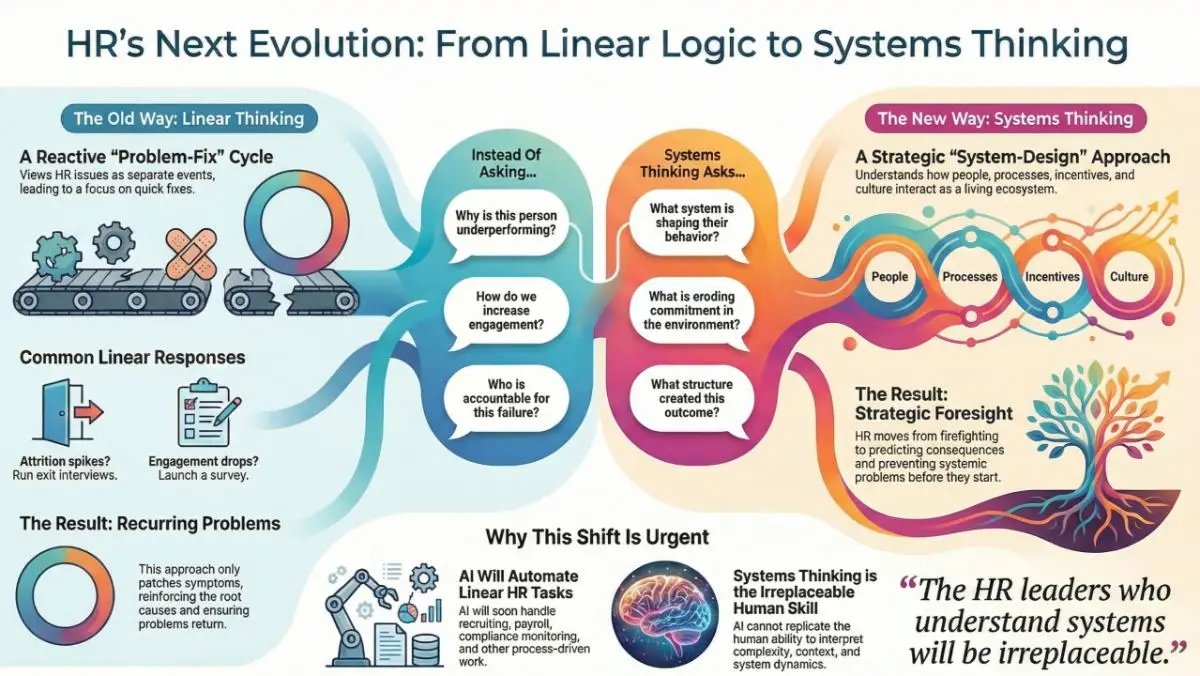
The Never-Ending Cycle of “People Problems”
Does this sound familiar? Your company experiences a sudden spike in attrition. A few months later, engagement survey scores dip alarmingly. Then, a persistent conflict erupts within a high-performing team. Each crisis arrives like an unexpected fire, and HR is called in with the extinguisher, scrambling to react, contain, and resolve the immediate damage. This cycle is exhausting, frustrating, and feels endlessly repetitive.
We treat these issues as isolated events—a person resigned, a team is unhappy, a project is struggling. But the deepest truth about organizations is that we fundamentally misunderstand these challenges. They aren’t random, one-off events that need to be fixed. They are predictable patterns, emerging from the complex system of your company’s design, culture, and incentives.
This realization is the foundation of a critical evolution in how we manage people and work. It requires a new lens for understanding your organization. And that shift will separate the HR functions that spend their days fighting fires from the HR leaders who design organizations that rarely ignite in the first place. The following counter-intuitive truths explain why this shift in perspective is no longer optional.
Your Company Doesn’t Have “Problems”—It Has “Patterns”
A traditional, linear HR response is conditioned by event-based logic: when someone resigns, the process is to run an exit interview. When a team underperforms, the solution is to send them to training. This approach isn’t wrong; it’s just incomplete because it treats every symptom as a standalone issue. With a systems thinking lens, problems become signals, not emergencies.
Attrition isn’t a standalone issue; it’s a delayed signal of unmet needs, misaligned incentives, or leadership capability gaps. Performance issues aren’t standalone issues; they often stem from unclear priorities or conflicting processes. Culture dips aren’t standalone issues; they arise from organizational design decisions and reward structures. The exit interview or performance review only captures the final symptom, not the root cause that has been developing for months.
This “quick fix” approach is destined to fail. Patches don’t change the pattern; they reinforce it, because everyone learns the same lesson: wait long enough and HR will treat the symptom again.
But the deepest truth about people systems is this: most HR problems are not events. They’re patterns. And patterns always originate from systems — not individuals, not one-off circumstances, and definitely not isolated moments in time.
Stop Trying to Fix People; Redesign Their Environment
Complaints like “employees aren’t motivated,” “managers aren’t giving feedback,” or “high performers are burning out” are almost always treated as personal shortcomings that require coaching or training. But most behaviors we label as “individual failures” are actually rational responses to the organizational system. This isn’t incompetence — it’s conditioning.
People behave according to the incentives, constraints, rewards, and unspoken rules of the environment around them. When managers consistently avoid difficult conversations, it’s almost never a personality gap; it’s because the organization punishes conflict, prioritizes harmony, lacks clarity on expectations, or rewards leaders for output regardless of people management quality. Burnout isn’t a failure of self-care; it’s a rational outcome when workload, recognition, and resource allocation systems make it inevitable.
Systems thinking doesn’t blame individuals; it diagnoses the environment they’re operating in. The most strategic shift HR can make is to move from “fixing people” to “redesigning the conditions” that shape their behavior. Environments drive behavior more persistently than personality ever will.
Is your HR function built to move the business?
Pathcraft helps founders and CHROs fix the people systems behind growth, from organisation diagnostics to people policy and IPO readiness.
AI Will Take the Tasks, Leaving Humans with the Wisdom
Artificial intelligence is poised to automate most of the linear, transactional work that has historically occupied HR. Within a few years, AI will absorb the work that follows predictable rules and repeatable steps, including:
Candidate screening and matchingRecruiting process flowPayroll transactionsFirst-round employee questionsCompliance monitoringPolicy interpretationPerformance data synthesisLearning recommendationsBenefits administration
This technological shift doesn’t make HR obsolete; it makes a different, uniquely human set of skills absolutely essential.
AI cannot replace the ability to interpret complexity, understand how incentives create unintended behaviors, or recognize subtle patterns in human social systems. It cannot grasp how a decision in one department will alter the dynamics of another or how a new structure might erode trust. This is where HR’s future value lies.
As AI absorbs task work, the differentiating power of HR will shift decisively toward the ability to see, explain, and shape systems. The HR functions that cling to linear execution will be replaced by software. The HR leaders who understand systems will be irreplaceable.
The Best HR Leaders Can See the Future
Linear thinking asks, “What problem do we need to fix right now?” Systems thinking asks, “If we make this decision, what new pattern will emerge six months from now?” This foresight is the superpower that elevates HR from a reactive function to a truly strategic partner. It’s the difference between firefighting and foresight.
Consider these common scenarios:
An organization rolls out an “unlimited PTO” policy. A systems thinker foresees that, without managers modeling its use, employees may paradoxically take less time off, leading to increased burnout.A company adds a new approval layer to reduce risk. A systems thinker predicts the second-order effects: slower decision-making, disempowered middle managers, and a stifled culture of innovation.A firm introduces a productivity dashboard to improve transparency. A systems thinker anticipates competitive behavior between peers, measurement gaming, and decreased collaboration—unless paired with mechanisms that reward team-level wins.
With a systems thinking lens, HR stops being surprised by problems. It develops the capacity to predict their emergence and design policies and structures that account for them from the start, moving from crisis response to structural prevention.
A New Lens for a New Era of Work
The future of HR requires a fundamental evolution from a reactive, process-driven function to a strategic, design-driven one. This shift is not optional. As AI automates linear tasks, leaders who master the ability to see and shape systems will become irreplaceable, while those who cling to managing processes will be replaced by software.
Systems thinking isn’t another tool, framework, or workshop. It is a new “lens” for understanding how an organization truly operates as a living, dynamic ecosystem. It is a worldview that shifts focus from blaming individuals to diagnosing the environment, and from fighting fires to designing fire-resistant structures. By adopting this lens, HR becomes indispensable to organizational intelligence and strategy.
As you reflect on your own organization, ask yourself this one question:
What is one recurring “people problem” that, when you look closer, might actually be a “system problem” in disguise?

Vikram Khanna is the founder of Pathcraft Inc and an HR consultant, facilitator and executive coach with twenty years in HR, organisation development and capability leadership across Solvay, Poonawalla Fincorp and more. He helps founders, CEOs and CHROs fix the systems behind culture and performance.