

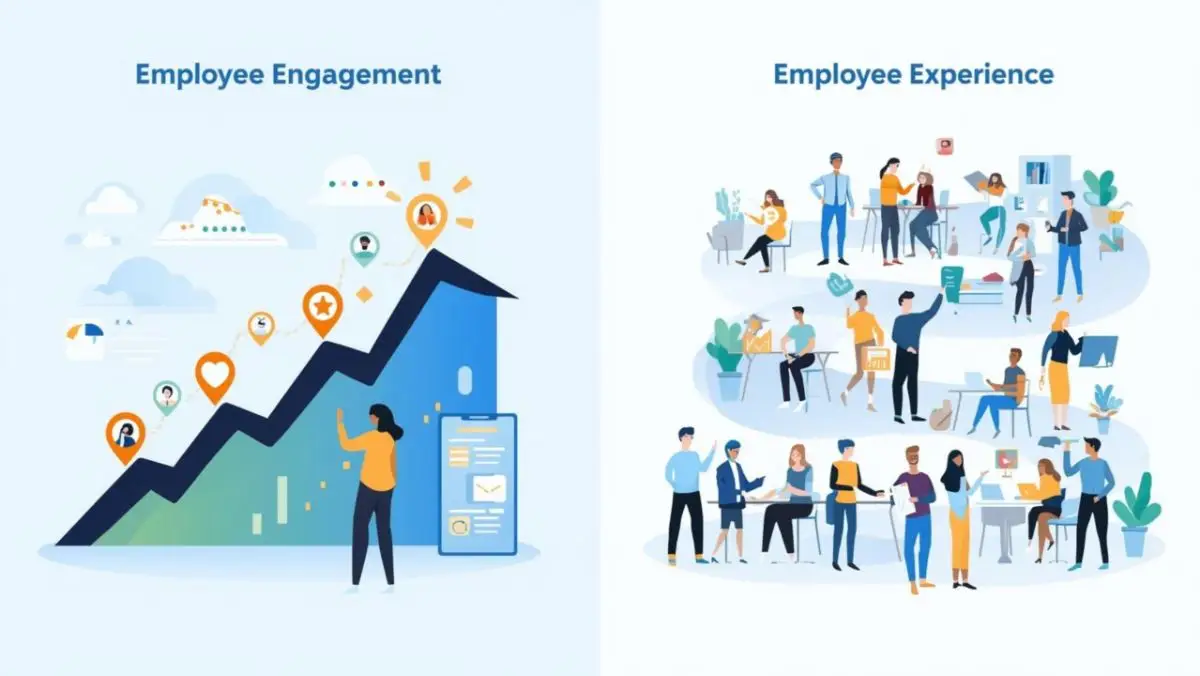
For years, the terms employee engagement and employee experience have been used interchangeably in boardrooms, HR dashboards, and leadership presentations. This conflation, though convenient, is limiting. It prevents organisations from designing holistic people strategies that honour the complexity of how individuals interact with work, culture, and leadership. In truth, these are not synonyms but distinct lenses through which we view the workplace—each with its own scope, drivers, and impact.
Beyond semantics: two fundamentally different questions
Employee engagement asks: How do employees feel about their work and the organisation? Employee experience asks: What do employees encounter, observe, and feel across their journey—from recruitment to exit?
This distinction matters. Engagement is a measure of emotional connection and commitment; experience is about the lived journey across countless touchpoints. One is episodic and often reactive, the other systemic and deliberately designed. Treating them as the same risks over-indexing on surveys and morale-boosting interventions while neglecting the structural environment in which engagement is either nurtured or eroded.
Drivers: meaning versus mechanics
Engagement thrives on meaning: recognition, growth opportunities, trust, and relationships. Experience, however, is driven by mechanics—workplace culture, leadership practices, technology, compensation, benefits, and the day-to-day flow of work. A high-potential employee may feel engaged because of a supportive manager, yet still suffer from a broken experience if HR systems are opaque or technology is outdated. When engagement falters, the instinct is often to launch campaigns or rewards programmes; when experience falters, the root cause is usually a deeper system misalignment.
Measurement and its blind spots
Both concepts rely heavily on metrics, but the emphasis differs. Engagement is traditionally captured through surveys, performance reviews, absenteeism, and turnover data. Experience requires a broader aperture: focus groups, interviews, observation, and analysis of behavioural data across multiple touchpoints. Too often, HR teams celebrate incremental gains in engagement scores while overlooking the friction points—onboarding delays, clunky HR systems, inconsistent policy application—that corrode the day-to-day experience. Without the latter, the former is unsustainable.
Is your HR function built to move the business?
Pathcraft helps founders and CHROs fix the people systems behind growth, from organisation diagnostics to people policy and IPO readiness.
Impact: where experience precedes engagement
The impact pathways further underscore their difference. A strong employee experience fuels attraction, retention, productivity, innovation, and employer brand strength. Engagement, in contrast, manifests as improved quality of work, lower absenteeism, and higher morale. Put simply: experience is the soil, engagement the bloom. Leaders cannot demand engagement if the underlying experience is mismanaged. Yet many organisations attempt just that, launching engagement drives without addressing the friction in the journey itself.
The strategic shift for HR leaders
This is where senior HR, OD, and L&D leaders must recalibrate. Engagement initiatives, though valuable, are often reactive—focused on boosting morale when indicators turn red. Experience, by contrast, requires a holistic, design-led mindset: shaping policies, processes, and culture that anticipate needs and enable employees to thrive. Designing for experience means accepting that every interaction—from an offer letter to a performance conversation—is a brand moment.
The shift, therefore, is not from engagement to experience, but towards integrating the two. Engagement cannot be divorced from the experience that shapes it, and experience has little value if it does not translate into authentic engagement.
Closing reflection
For organisations operating in volatile markets, the temptation is to measure what is easily quantifiable—engagement scores, turnover rates, survey responses. But sustainable performance demands something deeper: curating experiences that enable employees to feel valued, empowered, and supported across their journey. Engagement is the outcome; experience is the architecture. Senior HR leaders must hold both lenses simultaneously—designing the architecture of experience while nurturing the emotional fabric of engagement.
The challenge, and opportunity, is clear: stop treating employee experience and engagement as synonyms, and start managing them as two sides of the same system.

Vikram Khanna is the founder of Pathcraft Inc and an HR consultant, facilitator and executive coach with twenty years in HR, organisation development and capability leadership across Solvay, Poonawalla Fincorp and more. He helps founders, CEOs and CHROs fix the systems behind culture and performance.