

At 6:15 on a Monday evening, Rahul’s manager was staring at his sales dashboard.
The number was hard to miss.
62%.
That was Rahul’s achievement against his quarterly target.
Three months earlier, everyone had expected him to do well.
He had eight years of sales experience. His product knowledge was strong. His energy was infectious. He was the kind of person who volunteered for difficult customer conversations and stayed late when a deal was close.
Yet here he was.
62%.
His manager closed the laptop.
“He has lost his hunger.”
It was a familiar explanation. And perhaps it was true. But before deciding what was wrong with Rahul, what if we asked a different question?
“What is getting in the way of Rahul’s performance?”
That question takes us to one of the most useful, and often underused, frameworks in management:
The MARS Model
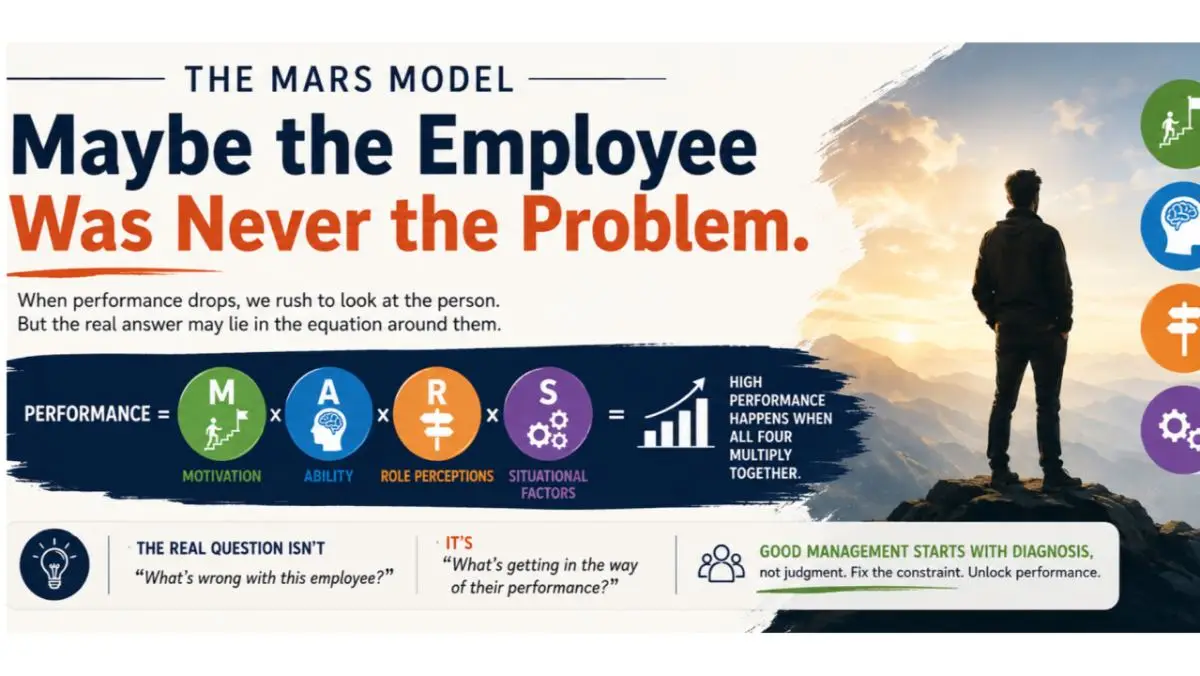
MARS = Motivation × Ability × Role Perceptions × Situational Factors
The equation looks deceptively simple. Its implications are not. Because sometimes, when an employee is underperforming, the problem is not the employee. Sometimes, the problem is the diagnosis.
The temptation to blame the person
Managers are human. When something goes wrong, we naturally look for a cause. And when an employee misses targets repeatedly, the easiest place to look is the employee.
“Not motivated.”
“Not capable.”
“Doesn’t take ownership.”
“Poor attitude.”
“Not committed enough.”
The labels come quickly. The diagnosis often comes later, if at all. But performance is rarely that straightforward. Imagine two employees who are both achieving 60% of their targets.
On paper, they look identical.
One may be working hard but lack the skills required to convert opportunities. The other may have excellent skills but be spending most of their time chasing the wrong customers. A third may have both the motivation and ability but be waiting three days for internal approvals before they can close a deal.
Same number.
Different problem.
Different intervention.
This is where the MARS Model becomes powerful.
It asks us to stop looking at performance as a characteristic of a person and start looking at it as the result of several conditions coming together.
The equation
Performance = M × A × R × S
Where:
M = Motivation
A = Ability
R = Role Perceptions
S = Situational Factors
And because these factors multiply rather than simply add up, a serious weakness in one can pull down the whole equation. That is the part managers often miss.
Let’s go back to Rahul
Rahul’s manager had already reached a conclusion.
“He isn’t hungry anymore.”
So the first intervention was obvious.
Push harder.
More reviews.
More targets.
More calls.
More pressure.
But something didn’t add up. Rahul didn’t look disengaged. He was still working long hours. He was still calling customers. He was still volunteering for difficult meetings. He clearly wanted to succeed.
So perhaps Motivation wasn’t the problem.
That brought the next question:
“Could he do the job?”
The answer seemed obvious. He had eight years of experience. His product knowledge was good. His previous performance had been strong. So ability was probably not the issue either.
Then came the third question:
“Did Rahul have a clear understanding of what was expected of him?”
This was where things became interesting.
The invisible problem: Role Perception
Rahul believed his job was to build relationships with large enterprise customers. His manager believed his priority was to close smaller, faster-moving opportunities. Neither had ever explicitly discussed the difference. Rahul was spending weeks nurturing strategic accounts. His manager was looking at the monthly revenue dashboard. Rahul thought he was doing exactly what he had been hired to do. His manager thought Rahul was failing to deliver. Neither was necessarily wrong.
They were operating with different definitions of success.
That is Role Perception.
And it is one of the most underestimated drivers of performance.
Managers often assume that because they have explained the role, the employee understands it.
But saying:
“Take ownership.”
is not the same as explaining what ownership means. Does it mean making decisions independently? Does it mean providing regular updates? Does it mean solving customer problems without escalation? Does it mean owning the final outcome even when other teams control parts of the process?
The manager may have a precise definition of ownership in their head.
The employee may have another.
That gap is role ambiguity. And role ambiguity can be expensive.
An employee may spend three hours perfecting something the manager considers low priority. Another may hit a quantity target while the manager is actually evaluating quality. Both employees may be working hard.
They may simply have different definitions of success.
But Rahul’s story didn’t end there
Once the priorities were clarified, Rahul changed his approach. His manager thought the problem was solved. It wasn’t. The numbers improved slightly, but they were still nowhere near target. So they went back to the MARS equation.
Motivation?
Yes.
Ability?
Yes.
Role perception?
Now much clearer.
Which left one uncomfortable possibility:
The environment.
Sometimes the system is the bottleneck
Rahul had enough leads. But many of them were poorly qualified. His pricing approval required multiple levels of sign-off. A proposal could sit with another team for several days. Product information was often outdated. Some of the customer information Rahul needed was sitting in systems he could not access directly. None of these problems appeared on Rahul’s performance scorecard.
But all of them affected his performance. The organisation had been measuring the output without fully examining the conditions producing that output.
That is the fourth element of MARS:
Situational Factors
Resources.
Technology.
Time.
Workload.
Information.
Processes.
Policies.
Team support.
Leadership support.
Dependencies on other teams.
All of these can influence whether someone’s capability actually turns into performance. And this creates an important managerial question:
“Have we created the conditions in which this person can succeed?”
Not:
“Have we told this person to succeed?”
There is a difference.
You cannot coach your way out of a broken system. You cannot train your way out of insufficient capacity. And you cannot motivate someone to overcome a process that consistently prevents them from succeeding.
Sometimes the employee needs development. Sometimes the system needs redesign.
The equation changed the conversation
Rahul’s manager eventually stopped asking:
“Why isn’t Rahul performing?”
And started asking:
“Which part of the performance equation is constraining Rahul right now?”
That led to a very different conversation.
M — Motivation
Does Rahul want to succeed?
Yes.
A — Ability
Does Rahul have the knowledge and skills required?
Developing leaders who change what happens on Monday
Pathcraft designs leadership programmes, offsites and coaching around a business decision, not a topic.
Yes.
R — Role Perceptions
Does Rahul understand what matters most?
Not initially. Now, yes.
S — Situational Factors
Does Rahul have the conditions required to convert effort and capability into results?
Not consistently.
The problem was no longer simply:
“Rahul is underperforming.”
It had become:
“Rahul is operating in a system with several performance constraints.”
That is a very different diagnosis.
And therefore, it demands a very different response.
The same symptom can have four different causes
This is where MARS becomes particularly useful. Imagine four employees who are all missing their targets. They look identical on the performance dashboard. But look underneath.
Employee 1: Motivation
They have the skills.
They understand the role.
They have the resources.
But they no longer see a reason to invest the effort.
Intervention: goals, recognition, incentives, career direction or role fit.
Employee 2: Ability
They are highly motivated.
They understand what is expected.
They have the resources.
But they simply do not yet have the skills.
Intervention: training, coaching, practice and feedback.
Employee 3: Role Perceptions
They are motivated.
They are capable.
The environment is supportive.
But they are solving the wrong problem.
Intervention: clarity, priorities, standards, responsibilities and measures of success.
Employee 4: Situational Factors
They are motivated.
They are capable.
They know exactly what they need to do.
But the system keeps getting in the way.
Intervention: fix the process, technology, workload, information flow or organisational dependency.
Four employees.
One performance problem.
Four different solutions.
Which is why:
Performance problem ≠ Performance diagnosis
And:
Performance diagnosis → Appropriate intervention
This is where performance management often goes wrong
We are very good at measuring outcomes. We are less good at understanding what produced them. Someone misses a deadline.
“Poor time management.”
Someone makes repeated mistakes.
“Careless.”
Someone misses a sales target.
“Not hungry enough.”
Someone doesn’t take initiative.
“Not engaged.”
Maybe.
But before turning a behaviour into a personality judgment, ask a few more questions.
Was the deadline realistic?
Was the person trained?
Were the priorities clear?
Did they have the information they needed?
Were there dependencies outside their control?
Did the manager explain what good looked like?
Did the system reward the behaviour the organisation actually wanted?
These questions do not make accountability softer.
They make it smarter.
There is a profound difference between excusing poor performance and understanding poor performance.
MARS is about understanding it.
And then there is the high performer who suddenly struggles
Perhaps the most interesting application of MARS is not the obvious underperformer. It is the high performer who suddenly isn’t performing like themselves. We’ve all seen it. Someone who has delivered consistently for years suddenly starts missing deadlines. A previously strong leader begins struggling with their team. A top salesperson’s numbers fall. A reliable employee becomes withdrawn.
The usual diagnosis is:
“They’ve lost their motivation.”
But what if they haven’t? What if the environment changed? They were promoted. Their role became more ambiguous. A new manager changed priorities. A new technology created a capability gap. A restructuring removed critical resources. The team doubled in size. The customer profile changed.
The person may be exactly the same.
The MARS equation around them has changed.
That is an important distinction. Because performance is not always a permanent characteristic of a person.
Performance is partly a product of the conditions in which that person is operating.
The manager’s job is not to find fault. It is to find the constraint.
This, for me, is the deeper lesson of the MARS Model.
Good management is not about asking:
“Who is responsible?”
It is about asking:
“What is constraining performance?”
Those are not the same question. Accountability asks who owns the outcome. Diagnosis asks what is preventing the outcome.
You need both.
Without accountability, performance management becomes an excuse. Without diagnosis, performance management becomes blame. The best managers do neither.
They diagnose first.
Then they hold people accountable for what they can reasonably control.
So what should a manager do tomorrow morning?
The next time someone on your team is struggling, resist the urge to immediately label them.
Instead, run the MARS check.
M — Motivation
Do they want to do it?
A — Ability
Can they do it?
R — Role Perceptions
Do they understand what they are expected to do and what good performance looks like?
S — Situational Factors
Does the environment allow them to do it?
Then ask the most important question:
“Which of these is the biggest constraint right now?”
Not all four.
Usually, one or two will stand out. And once you identify the constraint, the intervention becomes clearer.
If M is the problem → work on willingness.
If A is the problem → build capability.
If R is the problem → create clarity.
If S is the problem → change the conditions.
The principle is simple:
The solution should match the diagnosis.
And sometimes, the answer really is the employee
There is one important caveat. MARS should never become a framework for avoiding accountability. Sometimes the employee really is the problem. They may lack the motivation. They may lack the ability. They may repeatedly fail to understand or accept the expectations of the role. They may simply not be the right fit.That happens.
The value of MARS is not that it removes accountability.
It makes accountability more precise.
There is a world of difference between saying:
“This person is underperforming.”
and saying:
“We understand why this person is underperforming.”
The first is a judgment.
The second is a diagnosis.
Good managers should always prefer the second.
Back to Rahul
A few months later, Rahul’s performance was no longer 62%. It had moved significantly closer to target. Not because his manager had found a better way to pressure him. Not because Rahul suddenly became more motivated. The breakthrough came when they stopped asking what was wrong with Rahul and started examining the equation around him.
They clarified priorities. They addressed some of the process bottlenecks. They improved the quality of leads. And they gave Rahul clearer ownership of the outcomes that mattered.
The employee changed.
The manager changed.
And the system changed.
That is often what effective performance management looks like.
Not finding one person to blame.
Finding the constraint.
The equation I would want every manager to remember
When someone is struggling, don’t begin with a label.
Begin with a diagnosis.
Performance = M × A × R × S
Motivation × Ability × Role Perceptions × Situational Factors
Ask:
Do they want to?
Can they?
Do they know what to do?
Are we allowing them to do it?
Because sometimes the employee needs to change. Sometimes the manager needs to communicate better. Sometimes the system needs to change. And sometimes, as Rahul’s story reminds us, the answer is a little bit of all three. That is what makes performance management difficult. But it is also what makes good management worth doing. Because the real job of a manager is not simply to identify who is underperforming.
It is to understand why.
And once you understand the why, you have a much better chance of knowing what to do next.
Diagnose before you judge.
That may be one of the simplest rules of good management.
And one of the hardest to practise.

Vikram Khanna is the founder of Pathcraft Inc and an HR consultant, facilitator and executive coach with twenty years in HR, organisation development and capability leadership across Solvay, Poonawalla Fincorp and more. He helps founders, CEOs and CHROs fix the systems behind culture and performance.