

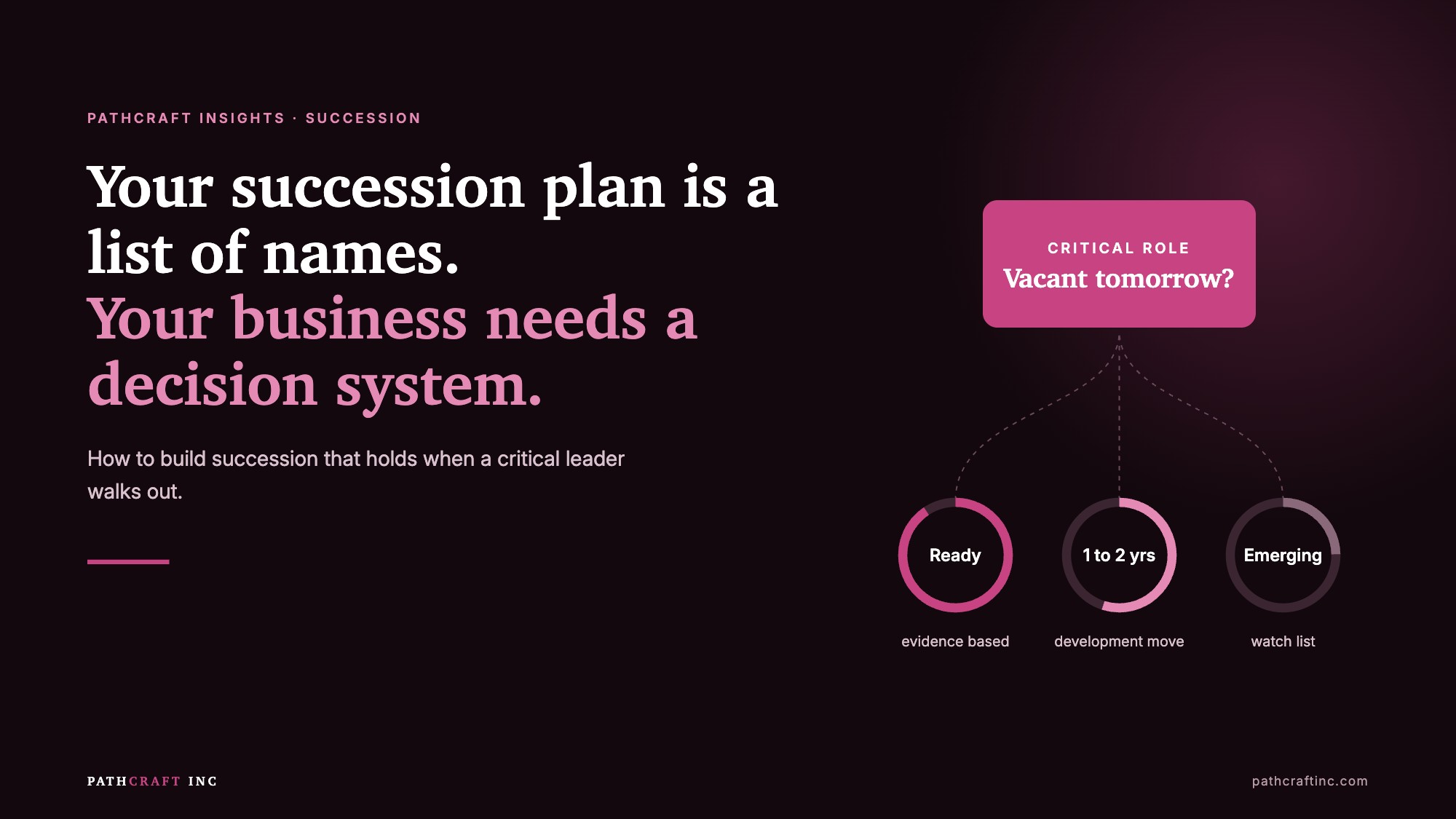
It usually starts with a resignation nobody saw coming.
A business head who has run the most profitable unit for six years tells the CEO she is leaving. The CEO calls the CHRO and asks the obvious question: who is ready? The CHRO opens the succession plan. Three names sit under the role. One left the company last year. One moved into a different function and has no appetite to come back. The third is talented, well liked and, by everyone’s honest admission, two years away.
The plan existed. It had been reviewed. It had even been presented to the Nomination and Remuneration Committee. It simply was not built to make a decision.
This is the pattern we see most often at Pathcraft when a founder or CHRO asks us to look at succession. The organisation has done the paperwork. What it has not built is the system that turns a list of names into a confident choice, made quickly, under pressure, with evidence the board can trust.
Why succession plans fail at the moment they are needed
Korn Ferry’s 2026 CEO and Board Survey of 250 directors and chief executives found that half of boards felt succession planning had started too late in their last CEO transition. Only 17% review their succession plans every quarter. That is at the very top of the house, where attention and advice are most plentiful. Below the CEO, the gap is usually wider.
In our experience, four failures sit underneath most succession plans that look complete on paper.
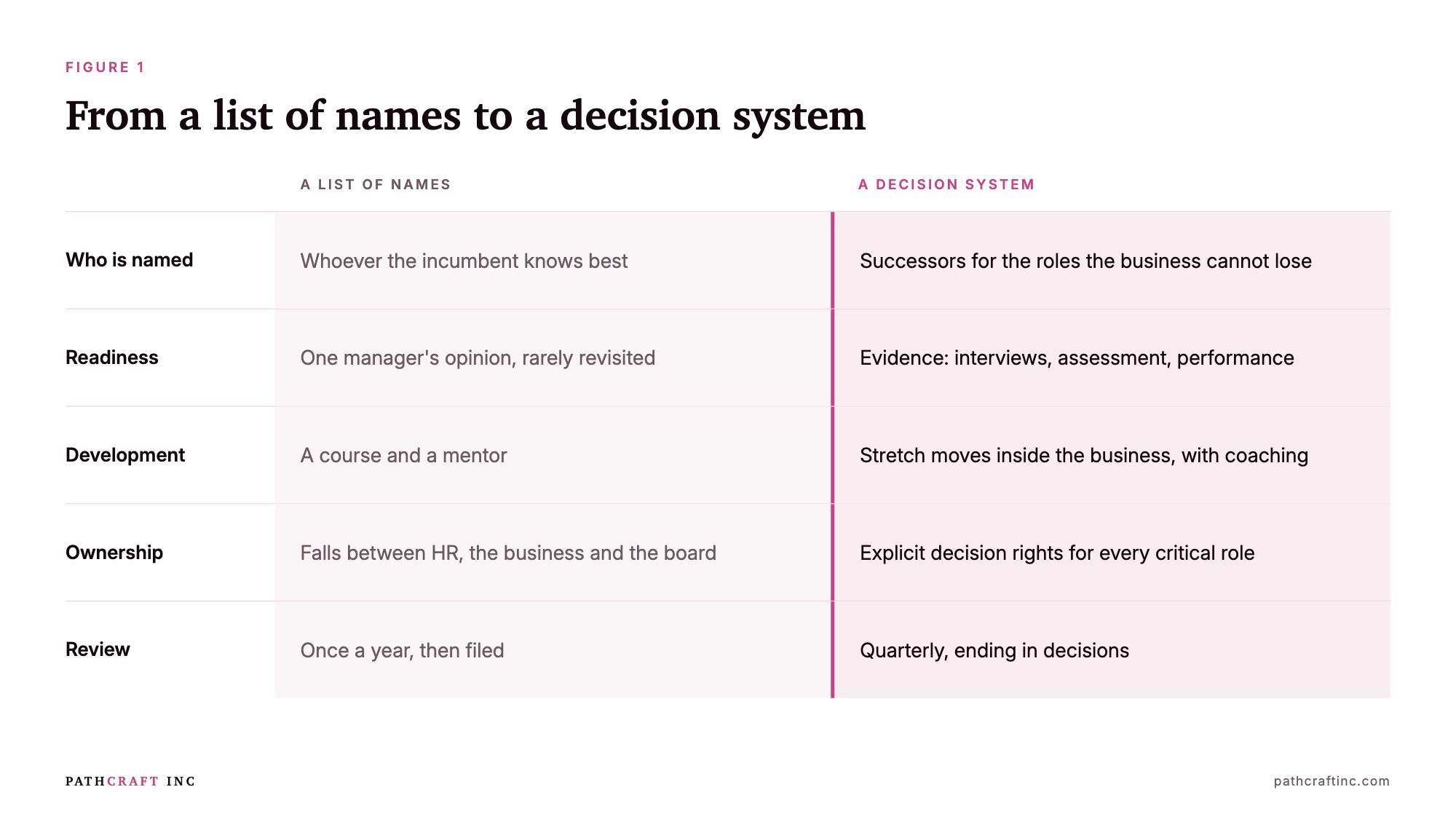
Names chosen by proximity. Successors are often the people the incumbent knows best, works with most, or simply likes. Proximity is not readiness. It is visibility.
Readiness decided by opinion. “Ready now” and “ready in two years” are usually the judgement of one manager, rarely tested and almost never revisited. When the role opens, nobody can say what that judgement was based on.
Development plans that never become development moves. A successor gets a course, a mentor and a line in the talent review. What they rarely get is the stretch assignment that would actually prepare them: the P&L, the difficult market, the turnaround.
Nobody owns the decision. HR maintains the plan. The business owns the role. The board asks questions once a year. When a vacancy arrives, the decision falls between all three and defaults to whoever moves fastest, which is often an external search started in a hurry.
What a succession decision system looks like
A succession decision system answers one question at any point in time: if this role opened tomorrow, what would we do, and how confident are we? It has five parts. None of them is complicated. The discipline lies in running all five together, every quarter.
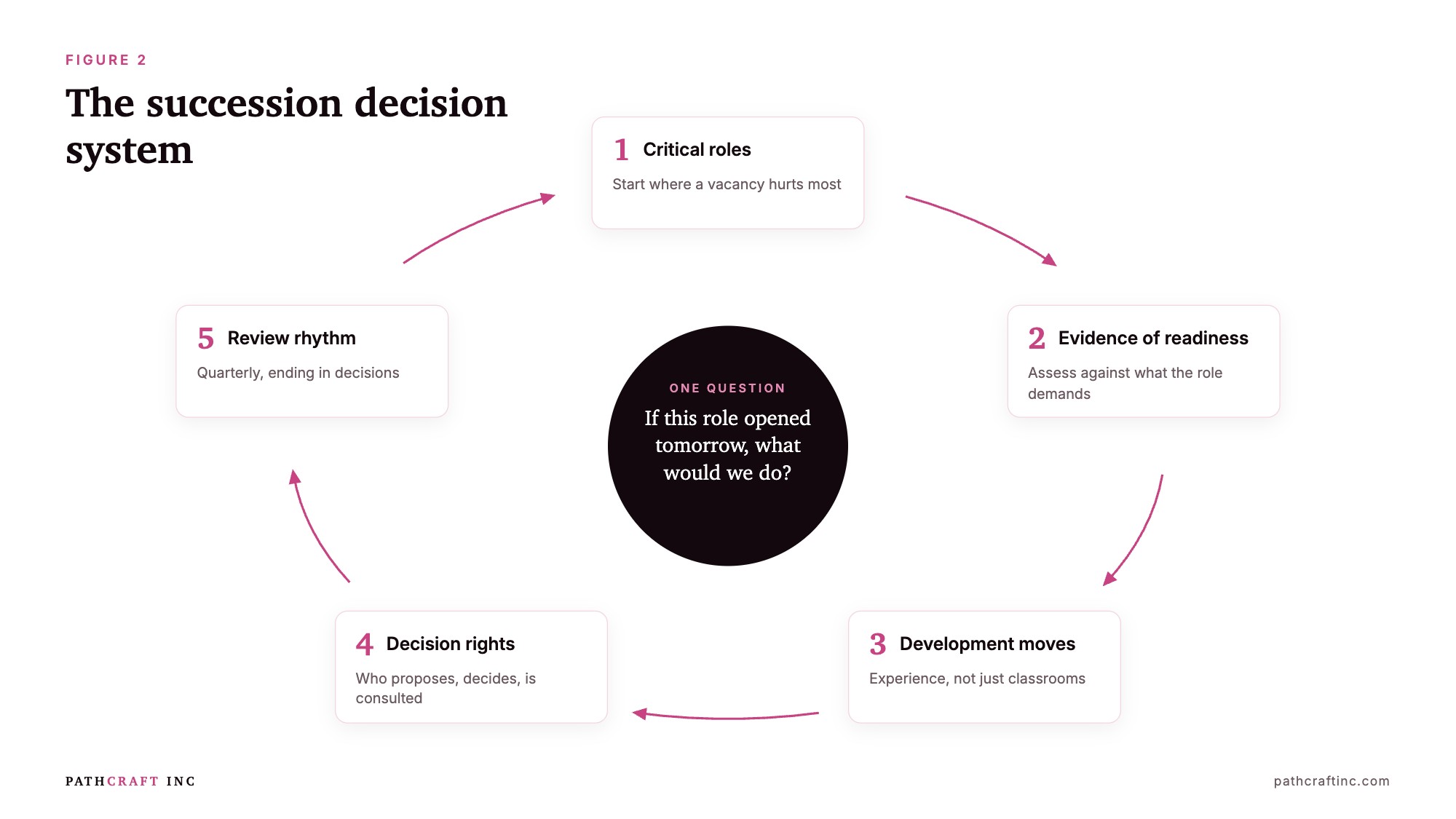
1. Start with critical roles, not senior roles
Most organisations start succession at the top of the organisation chart and work down. That produces long lists and thin thinking. Start instead with the roles where a vacancy would hurt the business most. A critical role usually has three features: it carries a material share of revenue, risk or customer relationships; it takes more than six months to fill and get productive; and much of the knowledge sits in one person’s head.
In a mid sized company, that is often fifteen to twenty five roles, not the top hundred. Some will be senior. Some will surprise you: the plant head who holds the regulatory relationships, the key account lead who personally manages a client worth a fifth of revenue, the finance controller who is the only person who understands how the numbers are built.
2. Replace opinion with evidence of readiness
Readiness should be a judgement you can explain to a board, not a feeling you defend in a meeting. That means assessing successors against what the target role actually demands, using more than one source of evidence.
Behavioural event interviews show how someone has handled comparable situations. Assessment and development centres show how they handle situations they have not yet faced. Psychometric tools such as Hogan add insight into derailers, the patterns that appear under pressure and quietly end careers at the next level. Performance data tells you what someone has delivered, which is necessary but never sufficient. The skills that made someone an excellent regional head are not the skills that make a national one.
The output is a readiness view with reasons attached. When the role opens, you are not debating whether someone is ready. You are checking whether anything has changed.
3. Turn development plans into development moves
Leaders are mostly built by experience, not by classrooms. The most useful question in a succession review is not “which programme should she attend?” It is “what does she need to have done before she can do this job, and where in our business can she do it in the next twelve months?”
That might be a cross functional rotation, a market entry, the turnaround of an underperforming unit, or acting cover for the incumbent during a long absence. These moves carry risk, which is exactly why they need to be decided deliberately, by the business, with the incumbent’s support. Coaching then helps the successor make sense of the experience while they are still in it.
4. Make decision rights explicit
Every critical role needs a clear answer to three questions. Who proposes the successor? Who decides? Who must be consulted? Without this, succession becomes a negotiation every time a role opens, and negotiations favour whoever holds the most power, not whoever holds the best evidence.
For the CEO and the CEO’s direct reports, the board and its Nomination and Remuneration Committee should own the decision, with the CEO and CHRO preparing the evidence. Below that level, the business head should decide, with HR accountable for the quality of the process. Write it down, and revisit it whenever the organisation changes shape.
5. Run a review rhythm, not an annual event
A succession plan reviewed once a year is out of date for most of the year. People leave, priorities shift, and a successor takes on a role that changes their trajectory. A light quarterly review of critical roles, backed by a deeper annual talent review, keeps the picture honest. Every review should end with decisions: a move approved, a gap accepted, an external search started early rather than late.
Where to focus first: the bench strength map
Not every critical role needs the same attention. Once you have identified the roles and assessed the successors, plot each role on two dimensions: the impact on the business if it fell vacant tomorrow, and the depth of the ready bench behind it.
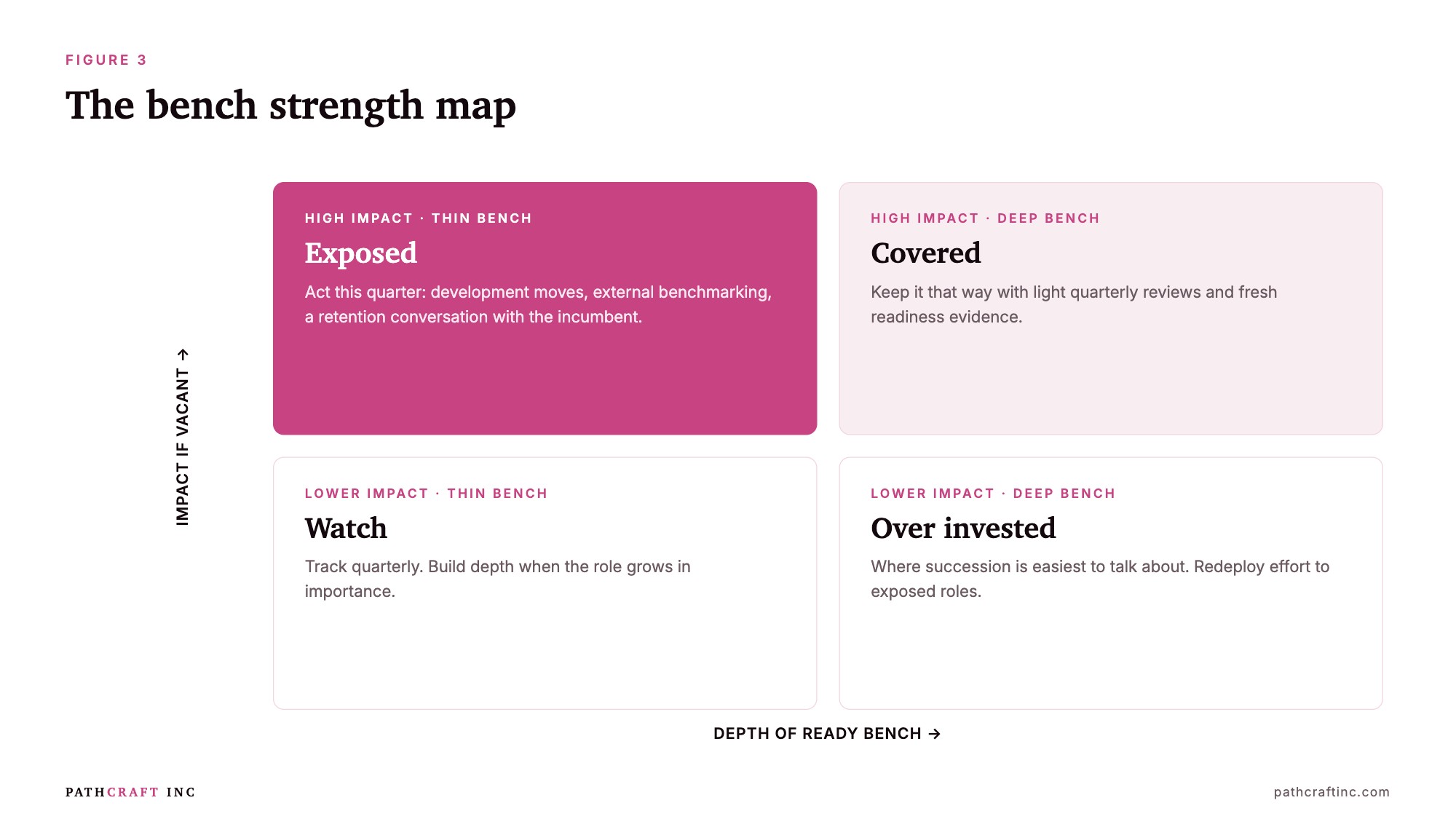
The top left quadrant, high impact and a thin bench, is where the risk lives. These roles deserve the first development moves, the first external benchmarking and, sometimes, a frank conversation about retaining the incumbent while the bench is built. The top right is covered: keep it that way with light reviews. The bottom left is worth watching but not worth panic. The bottom right, lower impact roles with deep benches, is often where organisations over invest, because those are the roles where succession is easiest to talk about.
One page, updated quarterly, shown to the leadership team. It changes the conversation from “do we have a plan?” to “where are we exposed, and what are we doing about it this quarter?”
What changes when the system is working
The difference shows up in three places. The first is speed. When a critical role opens, the conversation moves straight to confirming a successor and agreeing the handover, rather than starting a search from zero. The second is the quality of internal promotions. Successors step up having already done a version of the job, with coaching alongside, so their first year in role is spent delivering rather than surviving. The third is retention. High potential people who can see a credible path, and who are being given real moves rather than vague promises, are far less likely to take the call from a search firm.
There is also a quieter benefit. A leadership team that reviews its bench every quarter starts to talk about talent the way it talks about capital: where it is deployed, where it is at risk, and where the next investment should go.
How exposed is your leadership bench?
Take the free Succession Risk Scorecard: ten questions, five minutes, and a clear view of where you stand.
Why boards and investors now care
For listed companies in India, succession is a governance obligation. SEBI’s listing regulations require the board to satisfy itself that plans are in place for orderly succession to the board and senior management. For companies preparing for an IPO or working with private equity, the question arrives earlier and sharper. Due diligence teams ask about key person risk directly, and founder dependency, where too many decisions and relationships sit with one or two people, can weigh on how investors value the business.
A succession decision system gives a clear answer. It shows which roles matter, who could step in, how ready they are and what is being done about the gaps. That is a far stronger story than a list of names in a slide appendix.
A practical way to start: the first 90 days
You do not need a large programme to begin. In our work, a focused first cycle looks like this.
Weeks 1 to 3: identify the critical roles. Agree the criteria with the CEO and the leadership team, then map the fifteen to twenty five roles that matter most. Note where knowledge, relationships or approvals sit with a single person.
Weeks 4 to 8: assess the bench. For each critical role, name the realistic successors, including people outside the obvious reporting line. Gather evidence of readiness through interviews, assessment and performance data. Be honest where the answer is “nobody yet”.
Weeks 9 to 12: decide and commit. Build the bench strength map. Agree two or three development moves for the most exposed roles, write down the decision rights, and put the quarterly review dates in the calendar before the meeting ends.
At the end of ninety days you will not have solved succession. You will have something more useful: a clear view of where you are exposed, and a rhythm that keeps improving it.
Prefer to watch? In two minutes, here is what MS Dhoni’s four year handover at Chennai Super Kings teaches every leadership team about succession.
The test that matters
There is a simple test for any succession plan. Pick your three most critical roles. Imagine each incumbent resigns tomorrow morning. Could you name the successor, explain to your board why that person is ready, and say what you would do in the first thirty days?
If you can, you have a decision system. If you hesitate, you have a list of names, and the time to fix that is before the resignation, not after it.
At Pathcraft, this is the work we do with founders, CEOs and CHROs of growing, IPO bound and PE backed companies: critical role mapping, evidence based readiness assessment, development moves, and the decision rights that make succession stand up to board scrutiny. I have built succession at scale inside large organisations, including for more than 10,000 people at Poonawalla Fincorp, and I now bring that experience to leadership teams that cannot afford a gap.
Want a quick read on your own exposure? Take our free Succession Risk Scorecard: ten questions, five minutes, and three moves to lift your score. Or book a 30 minute conversation and leave with a clear view of where your bench is thin and what to do first.
And if you would rather listen, episode 8 of The Culture Margin looks at succession through the very different paths taken by Mumbai Indians and RCB.

Vikram Khanna is the founder of Pathcraft Inc and an HR consultant, facilitator and executive coach with twenty years in HR, organisation development and capability leadership across Solvay, Poonawalla Fincorp and more. He helps founders, CEOs and CHROs fix the systems behind culture and performance.