
A deeper exploration into the design flaws of traditional leadership programs—and what modern organizations must do differently.
“You cannot scale leadership by standardizing it. You scale it by designing for your own complexity.”
For over a decade, companies have relied on off-the-shelf leadership programs as a default solution to a complex problem. These programs—whether vendor-led, e-learning based, or facilitated via plug-and-play modules—offer a comforting promise: scalability, structure, and speed.
But here’s the unspoken truth: they rarely transform leadership behavior.
They might boost knowledge. They might check the “L&D investment” box. But when organizations examine whether these programs meaningfully impact how people lead in their context—especially during ambiguity, transition, or crisis—the ROI often falls short.
These programs aren’t designed for your leaders. They’re designed for the average leader in a generic organization that doesn’t exist.
Leadership development has become content-heavy and context-light. The result is training that’s consumed but not internalized.
Why Off-the-Shelf Leadership Programs Fail in Practice
1. They Assume Universality of Leadership
Leadership isn’t a universal experience. It’s deeply situated. Off-the-shelf programs flatten industry and cultural nuances into standardized frameworks. What it takes to lead in a regulated pharmaceutical company is vastly different from a hyper-growth tech startup.
2. They De-couple Development from Strategy
Programs often operate in silos, disconnected from business objectives. If leadership development isn’t aligned with the strategic direction of the organization, it becomes noise rather than a growth engine.
3. They Operate Outside the System
Leadership behaviors are shaped by systems—performance processes, peer norms, incentives. Off-the-shelf programs often ignore these realities, training individuals while the environment stays unchanged.
4. They Emphasize Exposure Over Application
Many programs prioritize exposure to tools over real-world application. Without practice, feedback, and reinforcement, exposure becomes a fleeting event rather than a learning journey.
The Changing Landscape of Leadership
Modern leadership is no longer about hierarchy and authority. It’s about navigating paradoxes:
- Clarity vs. Ambiguity
- Empathy vs. Accountability
- Speed vs. Deliberation
- Stability vs. Adaptability
Leadership is now a complex, adaptive practice. Development must mirror this shift.
We no longer need “trained leaders.” We need adaptive leaders with context-specific range.
The Case for Custom Leadership Development
1. Designed from Strategic Imperatives
Custom programs begin with a fundamental question: “What kind of leadership do we need to enable our strategy over the next 3–5 years?” Everything else follows.
2. Embedded in Culture
Custom development is built around an organization’s own values, language, and lived experiences. This relevance makes learning stick.
3. The Organization Becomes the Classroom
Programs use actual work—stretch assignments, live projects, peer coaching—as a medium for growth. Learning is not separate from performance. It’s integrated into it.
4. Identity, Not Just Skills
Great leadership development helps people answer: “Who am I when I lead?” This self-authorship is critical to sustained behavior change.
A Modern Blueprint for Designing Leadership Programs
| Legacy Approach | Evolving Approach |
|---|---|
| Training events | Continuous learning ecosystems |
| Generic content | Organization-specific experiences |
| Classroom-bound | Work-integrated, context-rich |
| Solo journeys | Peer-driven, system-aware |
| External validation | Internal reinforcement |
Practical Design Principles
- Design from strategy: Start with the business goals, not pre-built content.
- Embed development into the system: Align performance, succession, and feedback practices with learning.
- Coach for behavior change: Reinforce with real-world feedback, not just slides.
- Use real challenges: Development should be tied to business outcomes and complexity.
Metrics That Matter
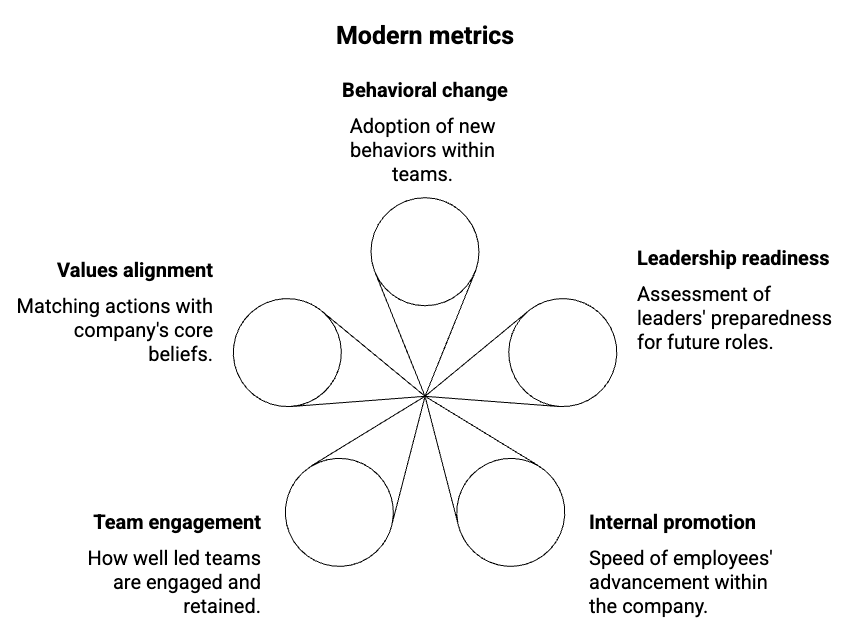
To measure leadership impact, shift from activity-based metrics to capability and performance indicators:
Final Thoughts: Development as Culture, Not Curriculum
Leadership development isn’t about more content. It’s about more relevance, more integration, and more impact.
Generic programs may still support foundational learning. But real transformation happens when leadership development becomes a cultural force—not a curriculum drop-down.
Leaders don’t emerge from modules. They emerge from challenge, context, and conscious design.
SEO Keywords: custom leadership development, leadership development strategy, off-the-shelf training, experiential learning, high potential programs, executive leadership development, L&D transformation