

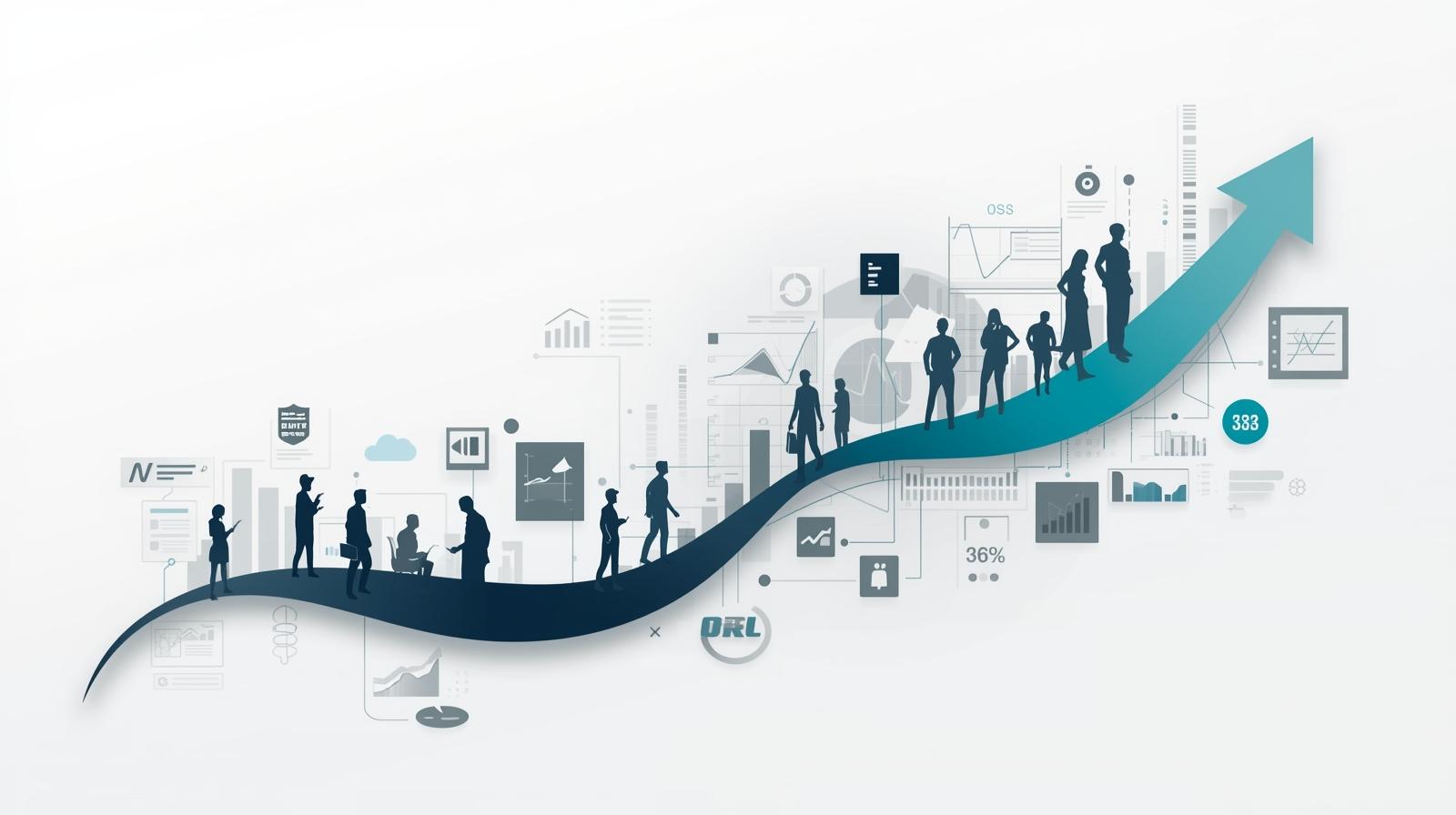
It’s time we stop treating learning like logistics — and start treating it like strategy.
Over the last few years, there’s been no shortage of investment in learning. Organizations have poured money into content libraries, workshops, LMS platforms, and vendor-led leadership programs. Employees have been trained, certified, and tracked. And yet — if we’re honest — most HR and L&D leaders would admit that we’re still struggling to answer one question with confidence:
Is any of this actually moving the needle on business performance?
The uncomfortable truth is that for many organizations, learning remains an isolated activity rather than a strategic enabler. It sits adjacent to the business, not inside it. It’s planned in calendar cycles rather than transformation cycles. And while it may tick compliance or engagement boxes, it often falls short of driving real capability shifts that show up in how people perform, lead, and adapt.
If we want different outcomes, we need a different approach. Not more programs, not more platforms — but a complete rethink of how we design, embed, and measure learning itself.
From Programs to Performance: A Strategic Rethink
The first shift we need is mindset. Learning is not about content delivery. It’s about performance enablement. And that means our strategies must be designed in service of business outcomes — not learning KPIs.
For example, if your organization is undergoing a digital transformation, the L&D strategy should not just offer courses on agile, analytics, or digital tools. It should ask: What behaviors do we need to see across the organization for this transformation to succeed? Do teams know how to collaborate cross-functionally? Are managers equipped to lead through ambiguity? Are frontline staff empowered to make decisions?
These are not abstract questions — they are strategic imperatives. And when learning is framed this way, it becomes clear that the role of L&D is not just to educate — it’s to activate.
The Limits of Traditional Learning Approaches
Unfortunately, many learning strategies today still follow an outdated playbook. We build content libraries filled with generic modules. We rely on attendance rates and feedback forms as proof of value. We assume that if people “know” more, they will “do” more.
But learning doesn’t work that way. Knowledge alone doesn’t drive behavior change. Context does. Practice does. Reinforcement does. If we fail to build learning environments that reflect the real-world complexity of work — and fail to support learners beyond the classroom — then we shouldn’t be surprised when the behavior doesn’t stick.
In many ways, we’ve confused exposure with capability. And that confusion has diluted the impact of learning.
Why Context is the Missing Ingredient
Here’s what we often miss: capability doesn’t live in the content. It lives in the context. People don’t learn in isolation — they learn in systems. And unless we design our learning strategies to account for the actual culture, pressures, norms, and workflows in which people operate, we will continue to see low transfer and limited impact.
Think about it: even the most inspiring leadership program won’t change how someone leads if their performance incentives, peer behaviors, or leadership modeling around them contradict what they just learned.
That’s why learning must be embedded in the system — not bolted on as an external intervention. It needs to be aligned with performance management, succession planning, transformation goals, and the day-to-day operating model of the business.
Learning That Lives in the Business
Strategic L&D is not about building more programs. It’s about designing learning ecosystems that live inside the rhythm of the business. That means moving away from large, one-time training events toward ongoing, applied learning that happens in the flow of work.
Imagine a company that doesn’t just teach feedback skills in a workshop, but redesigns its team meetings and performance reviews to actively practice and normalize feedback behavior. Or a sales team that doesn’t just learn negotiation theory online, but role-plays real client conversations weekly, with feedback loops built in.
This kind of integration is what moves learning from being passive to active. It’s what makes it stick.
Metrics That Matter
Another area ripe for transformation is how we measure success. For too long, we’ve relied on vanity metrics: how many hours of training, how many employees participated, how many completed the module.
But these metrics don’t tell us if people are leading better, collaborating more effectively, or making smarter decisions — which is what the business actually cares about.
Real impact is measured in role readiness, internal mobility, performance improvement, manager effectiveness, retention of high-potential talent, and the behavioral consistency that underpins culture.
If we want L&D to be taken seriously at the table, we need to speak the language of business — and prove our value in business terms.
Learning as a Strategic Lever
When designed well, L&D becomes far more than a support function. It becomes a strategic lever — one that enables organizations to build the capabilities required to execute strategy, navigate change, and grow sustainably.
For example, one global logistics company redesigned its learning strategy not around competencies, but around the challenges that each business unit was facing in-market. Instead of launching another blanket leadership program, they created learning journeys tailored to real-time decisions, client dynamics, and operational trade-offs. The result was not just more engaged learners — it was a measurable lift in decision velocity and customer retention.
That’s the power of designing learning with purpose and proximity.
Final Reflections: The Future is Designed, Not Delivered
As organizations face increasing volatility, talent shortages, and performance pressure, the demand for agile, high-performing, and aligned teams has never been greater.
And yet, no amount of technical expertise, strategic clarity, or ambition will deliver results if people don’t have the capability — or the confidence — to execute.
This is where L&D earns its seat at the table. Not by offering more programs, but by asking harder questions, designing smarter systems, and embedding learning into the way the organization works, not just how it trains.
Because in the end, strategy doesn’t fail in the boardroom. It fails — or succeeds — in execution. And execution lives in the everyday decisions of people.
The future of learning isn’t content. It’s capability. And capability is a design challenge we can no longer afford to ignore.
Tags: learning and development strategy, L&D ROI, behavioral change, performance enablement, strategic HR, organizational development, talent strategy