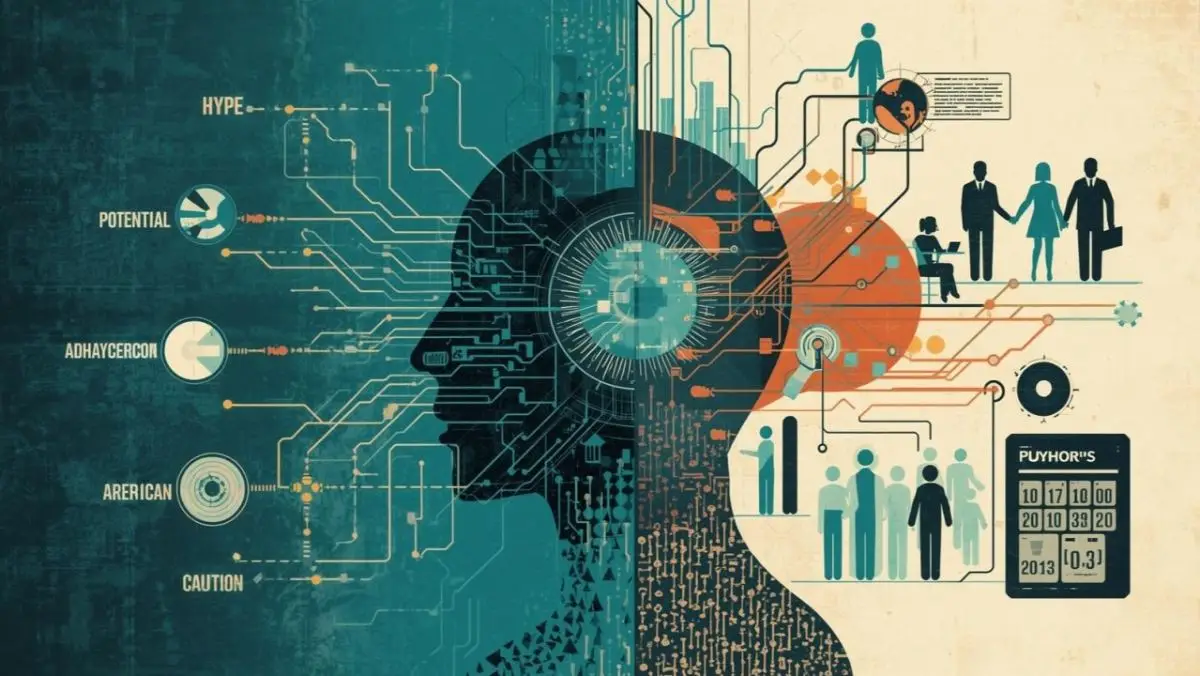


Every era invents its own theory of superiority. Once it was race. Then class. Then education. Today, it’s intelligence, artificial intelligence.
We’re living through a time when the most powerful form of hierarchy isn’t about wealth or title, but access: to data, to algorithms, to tools that seem to “know” more than we do. And like every earlier myth of superiority, this one too feels seductive, because it flatters us while distancing us from responsibility.
The Comfort of Machine Superiority
AI has quickly become the new authority we defer to. We trust its decisions, mimic its tone, and even measure our own intelligence against it. In the workplace, this shows up subtly in the unspoken assumption that people who “get AI” are somehow more evolved, more relevant, more future-ready.
The pattern is familiar. Every age builds its own hierarchy of worth. The 20th century worshipped the educated elite; the 21st is worshipping the AI-literate. The same psychological need is at play, to feel ahead of others.
And just like old theories of racial, intellectual, or cultural superiority, AI superiority too gives us a story: that those who can harness machines will inherit the future, and those who can’t will be left behind.
It’s not entirely false, but it’s dangerously incomplete.
Technology as the New Aristocracy
Walk into any organization today, and you can feel the divide. On one side, the AI evangelists fluent in tools, dashboards, and automation. On the other, the silent majority — anxious, skeptical, sometimes defensive.
We’re creating a new aristocracy of code, people who speak the language of algorithms and are crowned as “strategic,” “agile,” and “forward-looking.” Those who don’t are quietly labeled as “traditional,” “manual,” or “left behind.”
It’s the same old human story, superiority hiding behind sophistication.
But AI doesn’t discriminate. People do. The real danger isn’t in machines becoming smarter. It’s in humans using machine intelligence to reinforce existing hierarchies of privilege and worth.
The Psychology of AI Superiority
Why do we fall for it so easily? Because AI offers the oldest comfort in the world, certainty. It speaks in confidence, numbers, and patterns. It gives us answers faster than we can form questions. In uncertain times, that feels divine.
We stop asking if the data is biased. We stop checking who coded the system. We assume the algorithm knows best.
AI’s tone of authority soothes us, and that’s exactly how superiority has always worked. It comforts while it blinds.
As leaders, that’s where our real responsibility lies, not in resisting technology, but in refusing to romanticize it.
When Superiority Enters the Workplace
AI superiority isn’t just about machines outperforming people. It’s about how we treat people in response.
When performance systems lean too heavily on analytics, we risk reducing potential to a data point. When learning systems recommend content based on clicks, we risk turning curiosity into consumption. When we talk about “AI-first” strategies, we quietly make humans feel second.
Building capability for the AI era?
Pathcraft helps leadership teams design learning strategies and academies tied to the KPIs that matter.
We’ve seen this movie before, every time progress outpaces empathy.
Leaders must ensure AI doesn’t become another hierarchy, one that rewards technical comfort over emotional intelligence, and speed over depth.
The Irony: AI Mirrors, It Doesn’t Judge
Here’s what’s fascinating, AI doesn’t actually believe it’s superior. We do. AI only mirrors the data we feed it, the biases we bury in it, and the power structures we normalize around it. It’s a reflection, not a rival.
If our data is biased, our decisions will be too. If our definitions of performance are narrow, AI will enforce them. If our culture rewards domination over inclusion, algorithms will amplify it, faster and quieter than we ever could.
That’s not intelligence. That’s automation of old errors.
The Leadership Imperative
For senior HR and L&D leaders, the question isn’t “How do we use AI?”, it’s “What does AI reveal about us?”
Because the way we deploy it tells the truth about what we value:
Do we see technology as an amplifier of human potential, or a replacement for it?Are we teaching people to think with AI or bow to it?Are we using AI to widen opportunity or to preserve convenience?
True digital maturity won’t come from mastering tools, but from mastering judgment. It’s not about building smarter systems, it’s about building wiser leaders.
Reclaiming Our Humanity
The illusion of superiority has simply evolved. Once it was birth. Then education. Then expertise. Now, it’s machine fluency, the ability to speak AI’s language. But real leadership isn’t about being more intelligent than others, it’s about helping others become intelligent with you.
AI can scale information, but not understanding. It can replicate intelligence, but not imagination. That remains our human edge.
So, the next time someone claims, “AI will replace you,” perhaps the better question to ask is: “Replace which part of me?”
Because if it’s replacing our tasks, good. But if it’s replacing our humility, curiosity, and empathy — that’s when we’ve truly lost.
Final Reflection
Every age builds its own superiority myth. AI is simply ours.
The opportunity, and the responsibility, for us is to ensure this one ends differently. That instead of machines widening the gap between the privileged and the excluded, we use them to collapse it.
Because progress is not about making humans more like machines. It’s about making machines serve what’s most human in us.
And maybe that’s the real intelligence worth striving for.

Vikram Khanna is the founder of Pathcraft Inc and an HR consultant, facilitator and executive coach with twenty years in HR, organisation development and capability leadership across Solvay, Poonawalla Fincorp and more. He helps founders, CEOs and CHROs fix the systems behind culture and performance.