

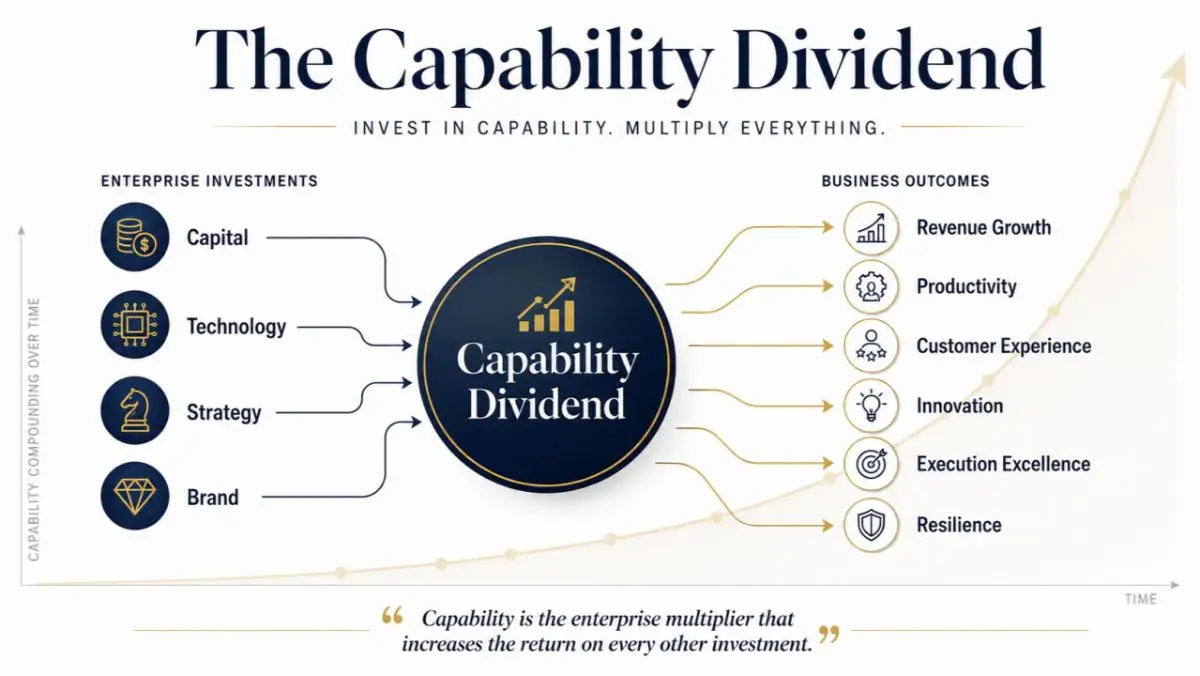
Every organisation knows the value of its financial capital. Buildings are recorded, technology investments are tracked, intellectual property is protected and cash flow is monitored with remarkable discipline. Yet ask an executive team a seemingly simple question, What is the value of our organisational capability? and the conversation often becomes surprisingly imprecise.
I have always found that difficult to understand.
After all, capability quietly determines the return on almost every investment an organisation makes. A new technology platform delivers value only when people know how to use it differently. An acquisition succeeds only when two organisations learn to work as one. A growth strategy becomes reality only when leaders, managers and teams possess the capability to execute it consistently.
We readily measure the investments themselves, but the one factor that determines whether those investments create value is often treated as a secondary consideration.
Perhaps capability has suffered from an identity problem. It has traditionally been viewed as an HR responsibility, something to be developed through learning programmes, leadership initiatives or talent interventions after the business strategy has been agreed. Experience suggests the opposite. Capability is not simply something that supports strategy. It shapes what an organisation is realistically capable of achieving in the first place.
That distinction is more than semantics. It changes where capability sits in business conversations.
Think about the last major transformation you witnessed. The organisation may have invested significantly in technology, redesigned processes and assembled experienced project teams. On paper, everything looked promising. Yet somewhere between launch and execution, familiar patterns began to emerge. Leaders interpreted priorities differently. Managers reverted to established habits when pressure increased. Collaboration became fragmented. Decisions slowed and customers experienced the consequences before internal reports reflected them.
When organisations examine these initiatives afterwards, the discussion often focuses on budgets, governance or implementation. Those factors matter, but they are rarely the whole story. More often than not, the technology functioned exactly as intended. The strategy was sound. What proved insufficient was the organisation’s capability to translate intent into consistent execution.
The same pattern appears in mergers and acquisitions. Financial models may be robust and strategic logic compelling, yet many integrations fail to realise their anticipated value. Rarely is this because the numbers were fundamentally flawed. More commonly, leadership teams underestimate the capability required to align cultures, establish shared decision making and create new ways of working.
Commercial ambition creates the opportunity. Organisational capability determines whether that opportunity becomes enterprise value.
Innovation provides another useful lens. Organisations frequently attribute innovation to creative thinking or breakthrough technology. Those elements certainly matter, but sustained innovation depends on something less visible. It depends on leaders who are comfortable making decisions with incomplete information, teams that collaborate across organisational boundaries and cultures that encourage experimentation without losing execution discipline. Innovation, in many respects, is capability expressed through behaviour.
These observations have gradually changed the way I think about capability. We often describe people as an organisation’s greatest asset. I have come to believe that capability is the more accurate description. People represent potential. Capability is potential translated into performance.
Unlike most enterprise assets, capability behaves differently over time. Buildings deteriorate. Equipment requires replacement. Technology inevitably becomes obsolete. Capability, when intentionally strengthened and consistently applied, compounds. While leadership judgement improves through experience, Collaboration becomes more effective through repeated practice. Decision quality matures as organisations learn from both success and failure.
Is your HR function built to move the business?
Pathcraft helps founders and CHROs fix the people systems behind growth, from organisation diagnostics to people policy and IPO readiness.
Capability may well be the only enterprise asset whose value increases through deliberate use.
That perspective also changes how we think about competitive advantage. Organisations rarely outperform because they possess resources their competitors cannot access. Capital can be raised. Technology can be purchased. Products are copied with increasing speed. Processes are benchmarked across industries. What competitors struggle to replicate is an organisation’s collective capability to adapt, make sound decisions and execute consistently over time.
Most HR competency models do not have a commercial anchor that surrounds the core HR disciplines. Business acumen, data literacy, digital agility, commercial judgement and execution excellence are presented not as optional additions, but as the context within which HR expertise creates enterprise value.
Viewed through this lens, it becomes less about HR capability and more about enterprise capability. Business acumen ensures investments in people support commercial priorities. Data literacy helps identify capability gaps before they become performance gaps. Commercial judgement guides where capability investment will produce the greatest return, while execution excellence ensures those investments become measurable business outcomes rather than well-intentioned initiatives.
This shift has particular significance for the role of the Head of Learning. For many years, Learning and Development has understandably been evaluated through programme delivery, participation, completion rates and learner satisfaction. Those measures reflected operational excellence, but they were never the reason organisations invested in learning. Every experienced learning leader has encountered the same paradox. A leadership programme receives outstanding evaluations, participants leave energised and the experience is widely praised. Yet months later, the commercial challenge that prompted the intervention remains largely unchanged.
The programme was successful.
The capability was not.
That realisation changes the role fundamentally. The question is no longer, What learning programmes should we design? It becomes, Which organisational capabilities will determine whether the business achieves its strategic ambitions? Learning then becomes one of several mechanisms for strengthening those capabilities, alongside organisation design, leadership, workforce planning, performance management and experience.
Perhaps this is why the role of the Head of Learning is quietly expanding beyond its traditional boundaries. The function is increasingly expected to understand business strategy before designing capability interventions, recognise emerging capability risks before they become operational risks and ensure organisational readiness keeps pace with commercial ambition. The focus shifts from delivering learning to stewarding one of the organisation’s most valuable assets.
If boards routinely examine financial capital before approving strategic investments, perhaps capability deserves the same level of scrutiny. Not because it sits alongside capital as another asset, but because it influences the return on every other asset the organisation already owns.
The conversation, therefore, is not about whether organisations should invest more in learning. It is about recognising capability for what it has quietly become, an enterprise asset that shapes growth, productivity, innovation, customer experience, resilience and long-term competitiveness.
Perhaps the next board discussion should spend a little less time asking whether the organisation has enough capital to pursue its strategy, and a little more time asking whether it has built the capability to justify the investment. Because one appears on the balance sheet.
The other determines whether the balance sheet grows.

Vikram Khanna is the founder of Pathcraft Inc and an HR consultant, facilitator and executive coach with twenty years in HR, organisation development and capability leadership across Solvay, Poonawalla Fincorp and more. He helps founders, CEOs and CHROs fix the systems behind culture and performance.