


“Strategy tells people what to do. Culture tells them what they’ll actually do.”
— The Pathcraft Inc. Perspective
Change doesn’t fail because of bad intentions or broken org charts. It fails because we continue to treat it as a project, not as a behavioral transformation.
Despite decades of investment in formal change models like PROSCI/ADKAR and Kotter’s 8 Steps, most organizations still see the same outcomes: poor adoption, superficial buy-in, and “zombie” initiatives that check the box but don’t change the culture.
At Pathcraft Inc., we believe it’s time to stop outsourcing change leadership to frameworks and start building internal behavioral change capability.
Why Traditional Change Approaches Fall Short
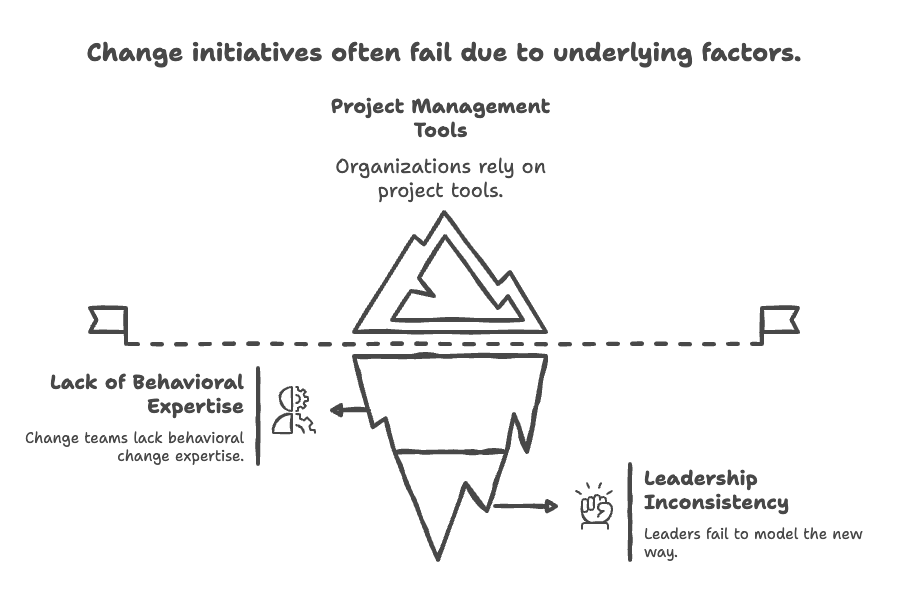
1. Projectifying People
Organizations manage change through project tools — Gantt charts, communications plans, stakeholder mapping — without equipping people to actually change behavior.
PROSCI, ADKAR, and Kotter are structured but shallow when misapplied. They don’t teach how people change — they teach how to manage templates.
2. No Real Behavioral Change Expertise
Most change teams lack understanding of instructional design, learning psychology, emotional regulation, or adult behavior change. They push announcements instead of enabling adoption.
3. Leadership by Declaration, Not Example
Change dies when senior leaders fail to model the new way. People mirror what they see, not what they hear. If legacy behaviors persist at the top, change is seen as optional — or worse, disingenuous.
Behavioral Models That Actually Understand People
1. Bridges’ Transition Model
Distinguishes between external change and internal transition:
- Ending: Letting go of old identity/processes
- Neutral Zone: Ambiguity, uncertainty, re-learning
- New Beginning: Real alignment and commitment
Lesson: Don’t skip the emotional middle. That’s where resistance — and growth — happens.
2. Kubler-Ross Change Curve
Tracks the emotional journey of change: Denial → Anger → Bargaining → Depression → Acceptance → Commitment.
Lesson: Leaders must know where their people are emotionally — not just where they are on a plan.
3. Gilbert’s Behavior Engineering Model (BEM)
Diagnoses what’s really blocking behavior change:
- Information: Do people know what’s expected?
- Incentives: Is motivation aligned?
- Environment: Are systems supportive?
- Skills: Do they know how to do it?
- Capacity: Do they have the time/resources?
Lesson: Move from blaming “resistance” to investigating what’s missing.
4. The “Switch” Framework (Heath & Heath)
Behavioral change = Direct the Rider (logic) + Motivate the Elephant (emotion) + Shape the Path (environment).
Lesson: Change is hard because it’s emotional. Simplify the path. Appeal to both heart and head.
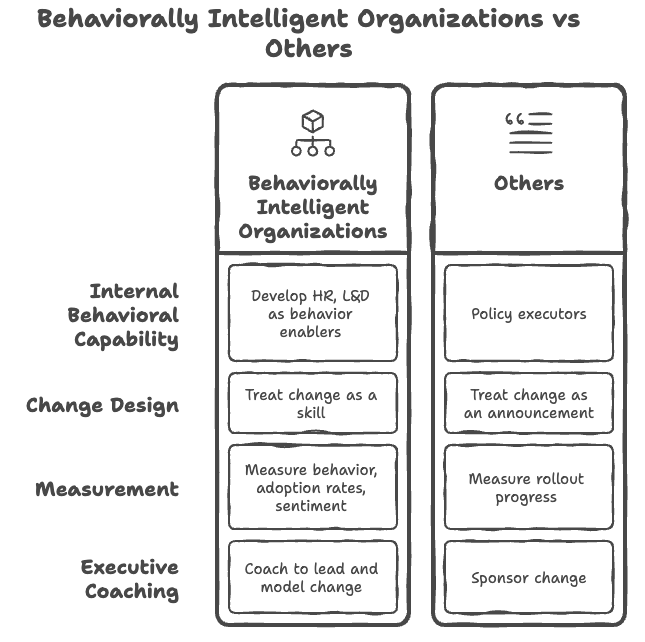
What Behaviorally Intelligent Organizations Do Differently
1. Build Internal Behavioral Capability
They develop HR, L&D, and leaders as behavior enablers — not just policy executors. We help teams embed behavioral science into change leadership.
2. Design Change Like Learning
They treat change as a skill, not an announcement:
- Use real-world practice and coaching
- Apply spaced learning and reflection
- Reinforce through peer-led learning and feedback
3. Measure Behavior, Not Just Rollout
Beyond progress updates, they track:
- Behavioral adoption rates
- Sentiment and cultural shift
- Peer feedback loops
4. Coach Executives to Lead, Not Just Sponsor
They understand that credibility comes from behavior. We coach senior leaders to model the change — not just fund or talk about it.
Final Word: Change That Lives Beyond Launch
Change doesn’t fail because people are resistant. It fails because organizations are unprepared to support real behavioral transformation.
At Pathcraft Inc., we don’t sell change templates. We build the human infrastructure for sustainable transformation — through coaching, capability mapping, and culture alignment.
📩 Ready to Lead Change That Sticks?
Let’s talk about how your organization can move from process-driven change to behaviorally intelligent leadership.
Contact@pathcraftinc.com or Schedule a Consultation
🔗 Related Services
- Change Leadership & Culture Transformation
- Executive & Leadership Coaching
- Organizational Capability Mapping
Target Keywords: why change initiatives fail, behavioral change models, change leadership, bridges transition model, switch framework, kubler-ross change, gilbert BEM model, organizational transformation strategy, PROSCI critique